The fashion industry spends roughly $150 billion a year making clothes, shipping them across the world, and burning the ones that don't sell. Beth Esponnette watched this happen and got frustrated.
She grew up in rural Maine with more trees than people around her. Her family included truck drivers and academics—honest labor and strategic thinking under the same roof. That combination stuck with her.
Weeks after finishing her Stanford thesis, she posted on a job board looking for a co-founder. Walden Lam answered. He'd grown up in Hong Kong, earned an MBA at Stanford, and run Asia-Pacific strategy at Lululemon. He understood the anxiety of traditional supply chains—the constant guessing about what would sell.
A year later, Kevin Martin joined them. He'd been building drones and robotic cameras since high school in Colorado Springs, then studied mechanical engineering at CU Boulder. He wasn't looking to start a company. But apparel being one of the dirtiest industries in the world—that problem grabbed him.
They founded Unspun in 2017 with a simple question: what if clothes were made only after someone wanted them?
The early prototypes were embarrassing, Esponnette admitted. But promising. Martin sponsored a capstone project at his alma mater, and CU Boulder students built their first 3D-weaving machine. One of those students, Brian Gormley, became the company's first employee. He drove the prototype from Boulder to San Francisco in a U-Haul.
Hardware takes years. So while they developed the machine, they launched custom-fit jeans. Customers scan themselves with an iPhone—30,000 data points. Choose style, fabric, fit. Two weeks later, jeans arrive sewn to their exact measurements.
No sizes. No inventory. No waste.
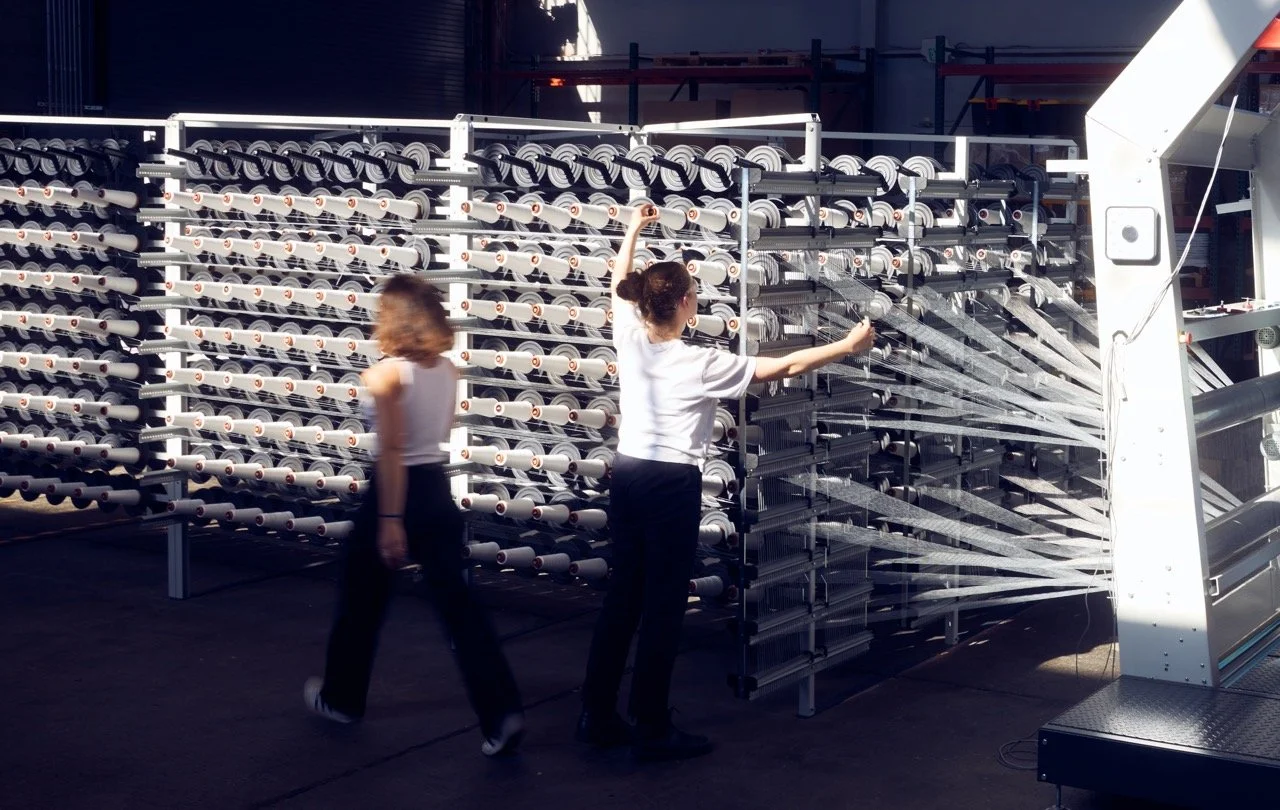
Unspun moved to Emeryville in 2019. TIME Magazine recognized the body-scanning technology as one of its Best Inventions that year, then recognized Vega—the 3D weaving machine—in 2021. Vega transforms yarn into finished pants in about ten minutes. No cutting, no sewing.
In March 2024, Walmart announced a pilot to integrate Vega into its supply chain, starting with men's chinos. The companies are working toward 350 machines across North America by 2030.
At 6655 Hollis Street, a neon sign now glows after dark. Most people walking past don't know what's happening inside—a technology that could bring garment manufacturing back to the United States, one pair of pants at a time.
"We started unspun when we realized we could not find a fashion company to lead us into the regenerative, sustainable, responsible, intentional future we want," Esponnette said. "And quite frankly need."